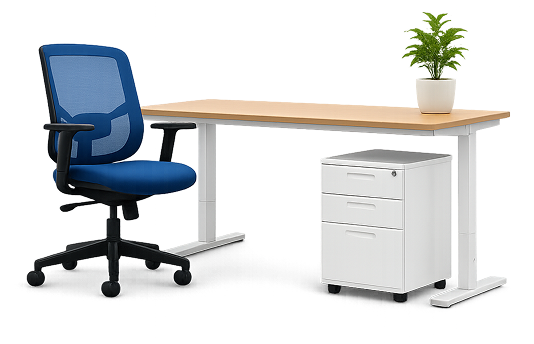
An executive office says something about leadership before a single word is exchanged in it. It’s where deals get discussed, where new hires get their first impression of company culture from the top down, and where a leader spends more hours than almost anywhere else in the building. The best executive office ideas balance authority with approachability — a space that feels put-together and serious without feeling cold or unused. It’s also one of the few rooms in most companies where a single, well-planned refresh can noticeably change how the whole office is perceived by clients and candidates alike. If your leadership spaces still look the way they did a decade ago, here are nine ways to bring a modern executive office up to date without a full renovation.
1. A Statement Desk
The desk sets the tone for the entire room. A large, clean-lined desk in a rich wood finish or matte laminate reads as modern and substantial without tipping into ostentatious. Skip the overly ornate, traditional styles that can make a space feel dated rather than distinguished, and prioritize a desk with enough surface area for dual monitors and paperwork without feeling cramped, plus a finish durable enough to withstand years of daily use without showing every scuff. A floating or waterfall-edge silhouette is a simple way to make even a fairly traditional desk shape feel current.
2. An Ergonomic Executive Chair
Comfort matters just as much at the top of the org chart as anywhere else. A well-upholstered, adjustable executive chair in leather or a high-quality leather-alternative material signals quality while supporting long days of meetings and focused work. Look for models with adjustable recline tension and headrest height, since executives often spend disproportionately more time in video calls than the rest of the team, often back-to-back and with less flexibility to simply stand up and stretch between them.
3. A Considered Color Palette
Modern executive office decor leans toward deep, grounded tones — navy, charcoal, forest green — paired with warm wood and brushed metal accents, rather than stark all-white or overly corporate gray. Color sets the mood of a room more than almost any other design choice, and darker tones tend to read as more confident and deliberate than a purely neutral palette, especially on camera during video calls.
4. Built-In or Modular Storage
Closed-door credenzas and low storage units keep files and supplies out of sight while doubling as display space for awards, books, or a coffee station — functional storage that also contributes to the room’s overall look. Choosing modular pieces rather than a single built-in unit also means the storage can move with the executive if the office itself ever changes, which matters more than it seems the first time a company relocates or restructures its leadership floor.
5. Layered, Intentional Lighting
Overhead lighting alone tends to feel flat and clinical. Adding a floor lamp, a desk lamp, and even accent lighting near shelving creates depth and warmth that fluorescent office lighting simply can’t replicate, and it makes the room feel considerably more comfortable during long afternoon meetings. Warmer bulb temperatures, generally in the 2700-3000K range, also tend to photograph and video-call better than cooler, bluish office lighting.
6. Curated Wall Art or Branding
A few well-chosen pieces — art, awards, or subtle brand elements — personalize the space without cluttering it. This is one of the easiest and most affordable executive office ideas to execute, and one of the most noticeable to visitors the moment they walk in, since it’s usually the first thing anyone’s eyes land on after the desk itself. Resist the urge to fill every wall, though — a couple of well-placed pieces read as intentional, while a crowded wall reads as an afterthought.
7. A Guest Seating Area
Two comfortable chairs or a small sofa near the desk, rather than directly across it, creates a less formal setting for one-on-one conversations, which visitors and employees alike tend to find more approachable than a straight desk-and-chair meeting. This kind of seating also gives the room a second function beyond solo work, which is useful in smaller offices where every square foot needs to earn its place, and it gives an executive somewhere other than a formal conference room to run a smaller, more candid conversation.
8. Seamless Technology Integration
Hidden cable management, a wall-mounted display for video calls, and wireless charging built into the desk keep the technology an executive uses daily from cluttering the room’s clean lines. The less visible the wiring, the more polished the whole office feels, and it also reduces the small daily friction of hunting for a charger or untangling a cord before a call.
9. A Touch of Greenery
One or two well-placed plants soften a room dominated by hard surfaces and straight lines, and they’ve been shown to modestly improve mood and air quality in enclosed offices. Low-maintenance varieties are worth prioritizing here, since an executive office is rarely the space someone has time to fuss over daily.
A Simple Tip Before You Redesign
Not every idea on this list needs to be implemented at once — even swapping the desk and chair, or adding better lighting and a plant, can meaningfully change how an executive office feels. One simple tip: choose two or three upgrades that address what currently bothers you most about the space, rather than trying to overhaul everything in one pass. Value Biz’s executive office furniture collection is built specifically around this kind of sleek, professional look, with pieces sized and finished for exactly this type of space.